“It's funny, it's only thanks to this interview that I even know what happened. From my perspective one day I hear online about some environmental disaster happening in the Gulf, the next the world is ending.” - Survivor of the Daemonspora being interviewed by a member of Project Alexandria.
Deamonspora:
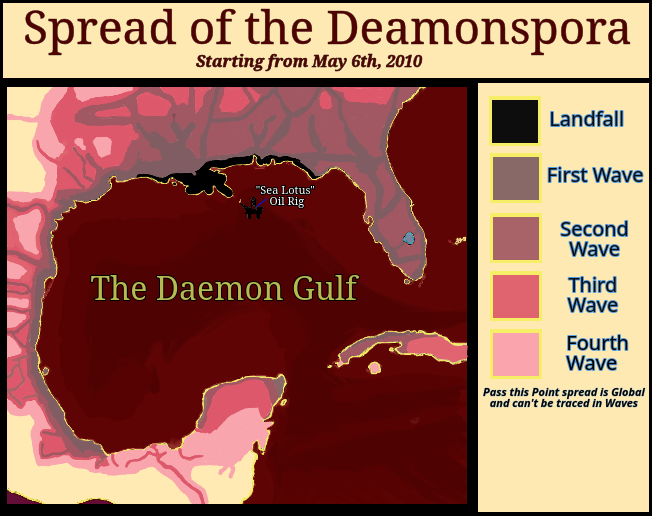
In the first half of the 21st century an ultra-deepwater oil rig called “Sea Lotus” began a new operation in the Gulf of Mexico, a month after the rig would go dark during the night followed by a massive explosion on the rig. The disaster and massive oil spill alone could have been a major event itself, but it ended up just a footnote as three days in the oil began to be replaced with a strange crimson substance. The substance quickly spread throughout the Gulf contaminating shores and water with what looked like thick algae blooms. (Map is WiP)
2009
March: The Petroleum branch (SSP) of the London based "South Seas and Americas Merchants Company" purchases mineral rights to drill for oil at a new site in Mississippi Canyon, Gulf of Mexico. SSP commissions the Intraocean Drilling oil rig "Sea Lotus" to drill the well.
June 22nt: A senior drilling engineer at SSP, warns that the metal casing for the blowout preventer might collapse under high pressure.
October 7th: A Intraocean semi-submersible rig begins drilling the well. Due to a bureaucratic mistake the Well Site is in a deeper part of the Macondo Oil Field then SSP planed. The Rig discovers traces of a unknown dead organisms the mud slurry, but the discovery is withheld by SSP in fear it may cause more delays.
November 9th: Hurricane Ida hits the Gulf
2010
March: An accident damages a gasket on the blowout preventer on the rig.
April 6th: SSP is issued permits for the well with the notation, "Exercise caution while drilling due to indications of shallow gas and possible water flow."
April 9th: Due to the earlier bureaucratic error SSP is forced to file a new exploration and environmental impact plan and the Sea Lotus has to readjust its equipment to the different part of the Macondo Oil Field, resulting in a additional 3 day delay.
April 12th: In opposition to Plasteel Suppliers consultant's advice, SSP chose to use a lower end casing system in order to save $3 million.
April 18th: SSP officials on the rig ignore advice to fully circulate the drilling mud from the bottom of the well all the way up to the surface to remove gas pockets and debris which can contaminate the cement, Only cycling a small fraction of the total mud used in the well
April 20th: Sea Lotus completes its drilling and the well is being prepared to be cemented so that another rig will retrieve the oil. SSP's Operations Drilling Engineer commits to using only 6 centralizers despite mediocre blowout preventer test results, and opposition from both the cement provider & rig engineer; stating "Who cares, it's done, end of story, will probably be fine and we'll get a good cement job,"
April 21st: Well is reported as potently have a severe gas flow problem. A crew is set in to do required cement bond testing after cementing is finished the next day.
April 23rd, 7am: In order to save $118,000 from a now 46 day delay, South Seas Petroleum cancels a recommended cement bond log test
- 11:15 am: Cement Crew and SSP officials leaves rig after brief celebration to seven years without an injury on the rig.
- 9:46 pm: Sea Lotus reports a rig shaking shock, followed by combustible gas intrusion warnings.
- 9:51 pm: Sea Lotus send out a garbled transition, followed by total silence.
- 9:53 pm: Gas from the wellbore erupts through the rig floor and explodes.
- 10:49 pm: Sea Lotus explodes again, this time much more violently.
April 24th: Coast Guard begins search and rescue, in the end it is able to find 28 survivors (out of 127) all in some form of serious medical condition.
...
April 25th, 11pm: Rig sinks. CNN quote Coast Guard Petty Officer Ashley Butler as saying that "oil was leaking from the rig at the rate of about 8,000 barrels (340,000 US gallons; 1,300 cubic meters) of crude per day."
April 26: A unknown crimson fluid begins to appear alongside the crude oil leaking out of the well. It is initially overlook due to the priority of cleaning up the oil spill
April 28th: The unknown crimson fluid has now fully replaced the crude oil as the main substance coming out of the leak. Unified Incident Command begins sending samples to the EPA, CDC, and other organizations.
May 2: Louisiana Governor Bobby Jindal declares a state of emergency.
May 3: Oil washes ashore at Venice, Louisiana.
May 4: The unknown crimson fluid is identified as a fungus like organism, it would latter be named Mycodaemonium (Demon Blight).
May 6: First tart balls containing Mycodaemonium washes ashore and begins to take root.
...
June 7: – Tarballs arrive on beaches in Pensacola, Florida.
Overview
Mycodaemonium (often called Demon-Blight) is a crimson to dark purple fungus-like parasite that infects living things and turns them into demons. It affects different beings to different extents with many plants and insects being largely unaffected outside the Red Miasma, and humans being extremely vulnerable. The Mycelium of the Blight is warm and pulsating. Before the invention of Forma, Demonblight had around a 40% mortality* rate, with most that recovered having been treated in the Onset stage.
Environmental Conditions and Effects
While Mycodaemouium prefers in wet and dark places like many fungi, the Blight can survive in an extremely variety of conditions. That said, harsh sunlight and arid climate do seem to hinder the growth and spread. The habit of the Blight in its mycelia form to absorb not only lifeforce but also heat, and biological contaminants; meaning that a cold and overly pristine environment can often be a sign of a hidden Demon Blight infestation. Sand or gravel left by petrification can also be a tell-tale sign of infestation in the area.
Infection
Infection happens much like fungi infection with spores entering the body through the lungs, stomach, and bodily fluids including open wounds. The spores can colonize skin but this is often easier to deal with and slower to result in a true infection. Short term, non-infection contact with Blight typically results in rash, temporary fatigue, or tissue necrosis.
Demonification
Stage 0: Onset
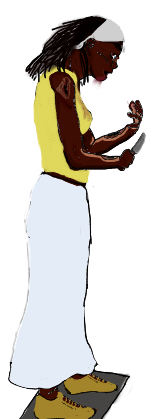
The stage zero marks the pre-Demonification initial infection. At this stage the Blight is not that different to a normal fungal infection and (though extremely resilient) can be treated with normal antifungals; with surface or very recent infections being cured with a high degree of success. Onset symptoms often include shortness of breath, fatigue, chills, muscle aches, and headaches. This stage can last days or weeks. This is sometimes followed by a “ghost” period of a few days where symptoms vanish before returning alongside Stage 1 symptoms.
Stage 1: Corruption
The first stage of Demonification starts with corruption of tissue. Corrupted areas will often not only look frostbite but also will be physically colder. In late stage 1, tumors containing Blight hyphae and bursting sporangium will start forming around areas of corruption. The spores in both their coagulated and aerosol variants resemble blood. These tumors are also commonly highly mutagenic creating inappropriate types of tissue and anatomical features in the area of infection. Once corruption has started there is only a ~36% recovery rate in a best case scenario, with a ~13% rate of fatality, and ~47% chance of the infected proceeding to the next stage (4% margin of error). This stage lasts a few weeks to months depending on the patient.
Stage 2: Hollowing
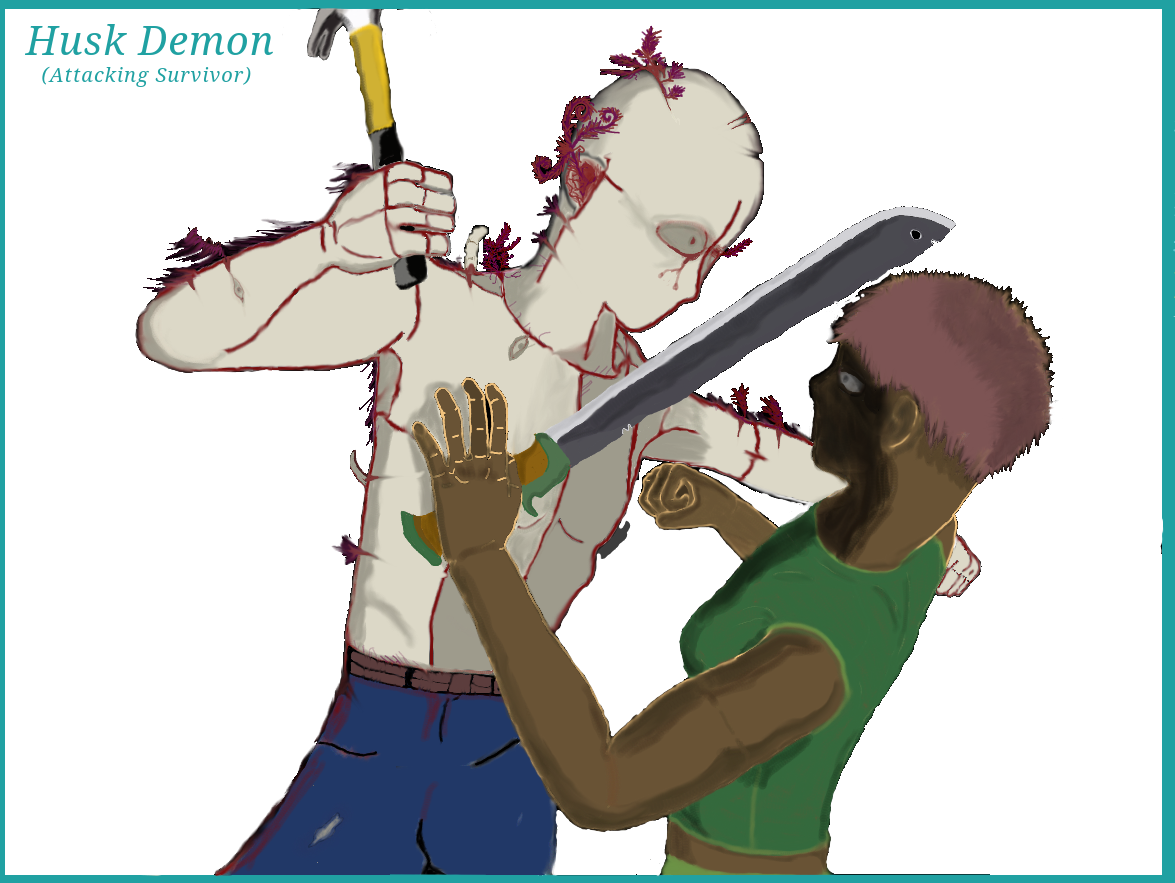
In stage 2 traditional medical treatment mostly loses effectiveness as the Blight forms a complete mycelia network and begins to corrupt the soul directly. For most animals, plants and insects this is where the process stops with the infected dying during treatment or husking. Husks act much like the pop-culture concept of Zombies, but human husks will keep a basic level of intelligence long into Stage 2. Husks will stay ‘alive’ so long as they find a sufficient amount of Pneuma to consume but once they run out the body will petrify to a limestone like material that retains small amounts of the victim's pigmentation. orma parts of an organic nature will sometimes reach Stage 2 infection however the Core always remains protected. Infected parts can be removed and disposed of.
Stage 3: Mutation
Stage 3 is where symptoms diversify and treatment becomes effectively impossible, however spore production also declines. Notes: ultrakill
> 3a: Beastification
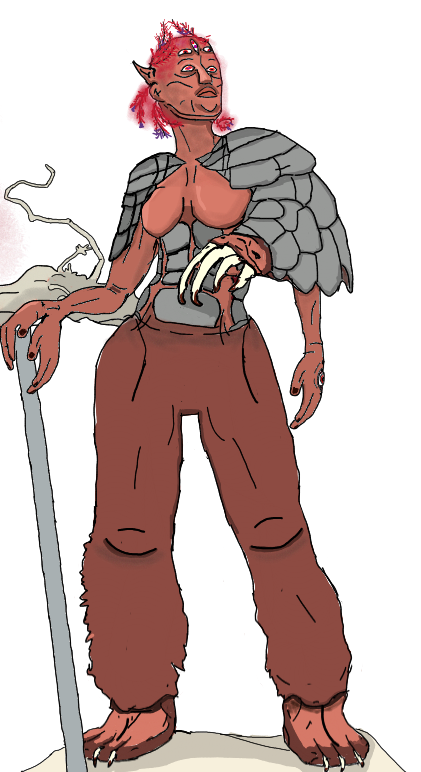
Beastification is seen as the most common result of entering Stage 3 Demonification, with the subject often becoming larger,tougher, and stronger than before. They lose high mental functions and turn to instinct.
> 3b: Rooting
Another common fate for entering Stage 3 is to become rooted into spore producing ‘flora’. Transforming into Zaqqum Trees or Harpy Oaks is common among non-violent victims and those that improperly try to kill them during late Stage 2. These demon trees and plants often carry rare oils and materials.
3c: Metamorphosis
The rarest and most dangerous form of Stage 3 Demonification, becoming Higher Demons. Higher Demons retain human intelligence and consciousness, but lose their sanity. This demon madness manifests differently depending on the individual and the type of Higher Demon they become; ranging from bloodlust, delusion, and dissociation, to obsession, depression, and mania.
Stage 4: Exhumanism
Stage 4 is a newly discovered step in Demonification by which Higher Demon (3c) becomes an Arch-Daemon, an intelligent but firmly exhuman being possessing great power and a “Kháos” soul.
Counters
Physical isolation from Demon Spores is the only effective prevention for Demon Blight. Demon Spores are difficult to completely repel or destroy from any given area forever, and such means are completely impractical on a mass scale, as such the process of cruxanimus (or putting the soul in a Core) is the only practical long term solution to Demon Blight prevention. Fully curing Demon Blight is only possible at initial Infection to Stage 1, through aggressive purification of infected areas. At Stage 2 only extreme purification followed by immediate cruxanimus can save the person. At Stage 3 the affected is declared “soul dead” and can’t be saved. Antifungals will typically only work on surface infections with only the strongest having any effect on an internal infection.
Machina Infection
While Demonblight can not directly “infect” a machine, but if the machine has Pneuma running through it (such a Golem or Nous AI) the Fugus can grow onto and into the machine feeding off the Pneuma. These infections are easy to eliminate but pose a major risk due to the spreading of spores and possible Machina Possession.
The Forma (Teleiaforma)
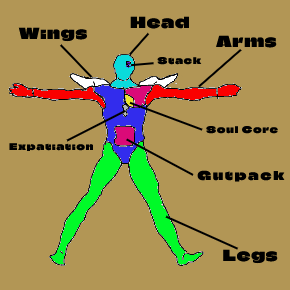
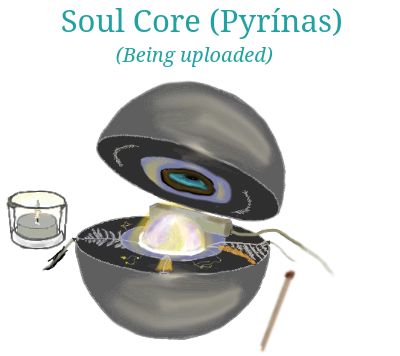
The Téleiafórma (Perfect Body) -- more often shortened to just Forma -- is a modular artificial body system made to interface and protect the Trinity Core, and by extension the Soul, from the Demon Blight.
Creation of the Soul Core and Forma
3 years after the coming of Daemonspora, a strange monk from a small Aegean island revealed to the world one of the great creations of humanity, the Téleiafórma. Pneuma Weave, a strange plant with silver fiber and honey amber, allowed for the soul to be removed, contained, and hooked up to a modular constructed body. While these revelations had many impacts, the most pressing would be the fact that Forma and other Pneuma technology gave a real means of fighting back against the Demon Blight. The Monk, beliving in divine perfection through self actualization and personalized modification of the physical form, made the Forma fully modular. Despite many attempts by others, Weave only grows in the Temple Commune and only the Monks there can make the Soul Cores.
PFD
Pneuma-Forma Dysphoria is the disparity between what the Pneuma (soul) sees itself as and the Forma’s construction. While Gender and Ethnic Dysphoria can cause problems (see optional rules Expanded Mechanics p.xx) PFD is largely a problem with more radical breaks from the human body. Parts from outside your [need name here] increase this dysphoria
The Trinitarian Soul
The invention of pneumatech came with the ability to study and manipulate the nature of the Soul. The major revelation was that not only did the Soul exist but that it was composed of three different particles or sub-souls that bind together similarly to the quarks in a hadron. It was also found that most beings did not have all three but those that did would form a fourth part of the soul colloquial called the Soul Kernel.
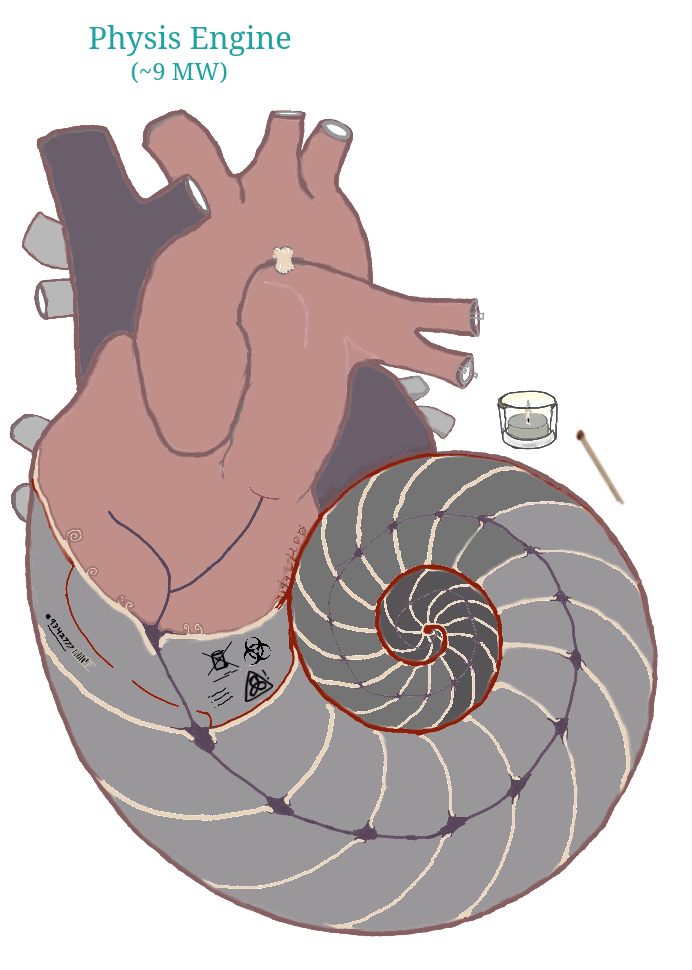
Physis (Body)
The Physical Soul
The Physis is the soul that governs the physical body and raw lifeforce. All living things have a Physis, and all material things contain Physis Pneuma in them.
Creation
The Physis is the first part of the soul to form, appearing at around the embryonic stage in most animals. It's also the easiest to create artificially.
Use
Physis refinement grants greater physical ability regardless of body, and makes one more resistant to outside control through the Forma. As the only part of the Trinity that can be reproduced reliably (and ethically) the Physis is used in a variety of soul-power tech.
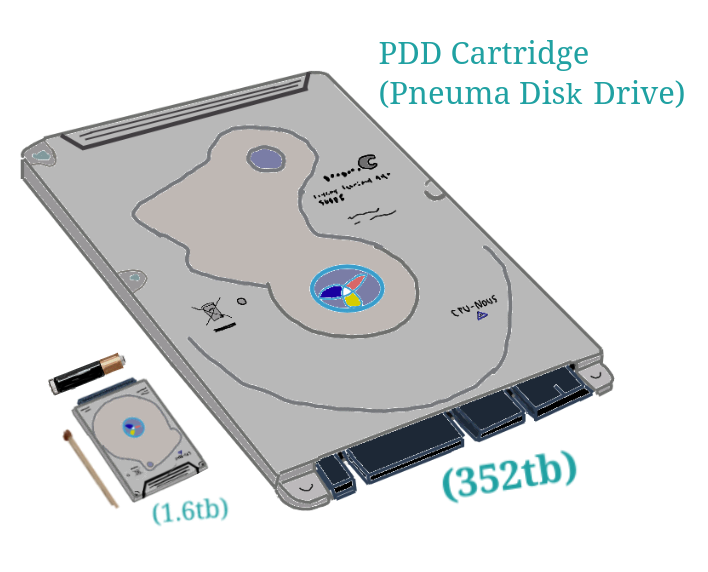
Nous (Mind)
The Mental Soul
The Nous is the second soul of the Trinity and is related to intelligent thought. More intelligent living beings, typically those that possess both sapience and sentience will form a Nous. Some extremely advanced and esoteric AI have been shown to form a Nous, often without a Physis. Nous Pneuma can be found in the brains of living organisms and will generate in small amounts in high energy electromagnetic reactions.
Creation
The Nous typically forms around the mid to late Fetal stage in animals. Nous have been found in some plants and fungal networks, much to the confusion and worry of some researchers. With AI it can often be a bit of a “chicken and the egg” with the presence of a Nous greatly affecting the mental flexibility and personhood of a AI but it being unclear if self-awareness cause the formation of the Nous or if a significant intelligent AI gaining a Nous leads to it becoming self-aware.
Use
Refining one's Nous helps one perform better at mental and skill based tasks regardless of bodily limitations. A strong Nous helps one resist mind control both biological and digital. While Nous AI are vastly superior to normal, they are most hard to replicate and present a number of ethical and practical concerns to using them.
[Match and Tea Light for Scale]
Kardia (Heart)
The Divine Soul
The Kardia is the third and most cryptic of the Trinity. As far as it is known the Kardia only forms in humans and human-related beings. Once the Kardia forms it will interlock with the Physis and Nous into a Trinity after which in the area where they overlap a divine spark will appear, this is often called the Soul Kernel. Kardia Pneuma has been found in humans, things that were human, and rarely things made by humans. Miniscule amounts of Kardia Pneuma have been claimed to be found in outer space, however there is no concrete proof of this.
Creation
The Kardia forms at the moment of a person's first independent breath. No way has ever been found to artificially create the Kardia in isolation, nor does it seem like a Trinity can be split apart after forming without total destruction.
Use
While the Kardia seems to be related to emotion and empathy it doesn’t seem necessary for these things. The main thing refining the Kardia seems to do is empower one’s pneumaturgy.
World Today:
It has been 30 years since the Daemonspora, the world today is dominated by isolated cities, stateless organizations and rump remnants of pre-blight governments.
The Blood Seas
The Water from which the Daemonspora first sprang, the world oceans have become
Larva of Ierós Technítis and Kópos Credit System
Creators of the forma technology, theo-socialist
The Demon Wastes
The lands taken by the Red Fog, these are the areas that have been totally lost to the Blight.
 Stage 0: Onset
 Stage 3: Mutation